Released: 2010
Creative Director: Patrice Désilets
Lead Game Designer: Steve Masters
Creative Director: Patrice Désilets
Lead Game Designer: Steve Masters
Assassin’s Creed: Brotherhood is the third major instalment of the Assassin’s Creed franchise. The story continues the adventure of Ezio Auditore da Firenze - a young assassin living in 16th Century Italy, with the narrative focusing primarily on Rome. Rome is currently under the influence of the Borgia - a dictatorial family with ties to politics, royalty and the church. Essentially, they control everything.
Now as much as I would want to explain and describe every element of this engaging story, that is not the purpose of this document. The purpose here is to discuss the level and specifically the city of Rome.
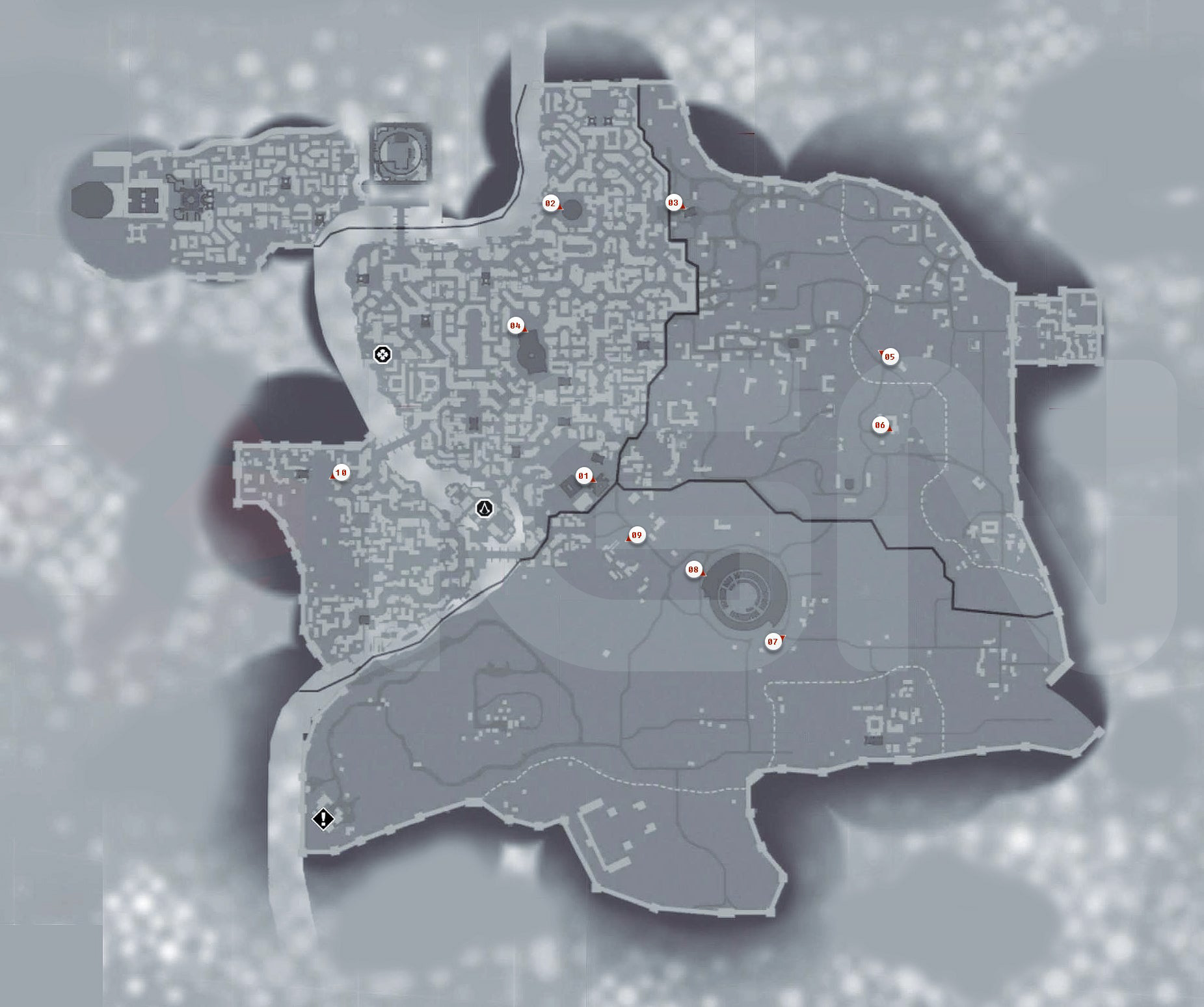
Here are two maps of Rome. The first is the player’s map of Rome in Assassins Creed: Brotherhood the second is a tourists’ map showing popular landmarks.
Here are two maps of Rome. The first is the player’s map of Rome in Assassins Creed: Brotherhood the second is a tourists’ map showing popular landmarks.

Rational Game Design
These two maps are, unsurprisingly, very similar, the Colosseum and citadel are in the correct locations and the river has accurate meanders and bends, even the streets are precisely placed to reflect how the city may have looked in the 16th century. This is key to a good level design, as the player needs to feel a part of the world they are playing in - games are all about escapism.
This brings me to my first major point: Escapism versus Reality and finding the balance. In a climatic sequence, Ezio must sprint from the Castel Sant’Angelo to the Sistine Chapel in under four minutes. In reality this is doable as the distance is about 1.5 kilometres and the world record for this distance is 3 minutes and 26 seconds (currently held by Hicham El Guerrouj), however this time was achieved in perfect race conditions, on a smooth surface, with no bad guys chasing after them, and with the finish line in clear sight. So how does AC: Brotherhood achieve a good balance between reality and escapism? This is where rational game design comes into play.
Rational game design is about focusing on the main gameplay elements and teaching the player how to achieve the goals instead of telling them how to achieve them. This sprint through Rome is a major test of the player’s knowledge and skill that they have developed over the hours of playing the game. The player has been taught how to climb walls, leap great distances, effectively avoid enemies, weave and dodge through NPCs and, most crucially, where they are going.
Rational game design is about focusing on the main gameplay elements and teaching the player how to achieve the goals instead of telling them how to achieve them. This sprint through Rome is a major test of the player’s knowledge and skill that they have developed over the hours of playing the game. The player has been taught how to climb walls, leap great distances, effectively avoid enemies, weave and dodge through NPCs and, most crucially, where they are going.

The Basilica di San Pietro is a location that the player has seen many times throughout their adventures and has become engrained in their memory, this doesn’t mean that entering it is no less challenging as the player has not yet been allowed in.
After navigating twisting and turning streets between the citadel and the basilica the player finally emerges onto a large plaza. On a map this is identifiable as there will generally be no structures and the map will look bare. This also helps the player find their way through a quick glance at the map they will be able to identify their target location.
After navigating twisting and turning streets between the citadel and the basilica the player finally emerges onto a large plaza. On a map this is identifiable as there will generally be no structures and the map will look bare. This also helps the player find their way through a quick glance at the map they will be able to identify their target location.
Contradictory to usual Assassin’s Creed gameplay the player should stay at ground level. This is shown by the accurate portrayal of the basilica. Currently, the basilica is an ornate and opulent building, however, back in 1502 when the game is set the basilica is a more modest building with a plain façade and limited architectural detailing. The player should intuit that this building is non-climbable and therefore must have a ground level access point.

If the mission was to be a compendium of all the mechanics the player has been taught through the game then the mission would be almost impossible so removing the element of stealth the mission becomes merely challenging.
As they say hind-sight is 20/20 and being able to reflect and analyse the level makes it seem as though all of this is very obvious whilst playing - it is not. Coming from an interior and spatial design background my first thought should have been “Go to the front door”. Under time pressure, enemies closing in and the threat of having to do the same run over and over again, the mind automatically went to What is typical Assassin’s Creed gameplay?. This added to the pressure of this mission as the game took a small be not insignificant change of pace. Instead of stealthily sneaking in through the open window on the top floor and quietly descending through a series of stairwells, the player runs full throttle into the basilica. Stealth is almost impossible here as you have been chased for the past three minutes by multiple enemies, who are all on high alert.
There is a sense of desperation and rashness to Ezio’s actions and this change of gameplay helps convey the narrative. This is the crux of the story and if Ezio doesn’t reach the basilica in time then all is lost.
As they say hind-sight is 20/20 and being able to reflect and analyse the level makes it seem as though all of this is very obvious whilst playing - it is not. Coming from an interior and spatial design background my first thought should have been “Go to the front door”. Under time pressure, enemies closing in and the threat of having to do the same run over and over again, the mind automatically went to What is typical Assassin’s Creed gameplay?. This added to the pressure of this mission as the game took a small be not insignificant change of pace. Instead of stealthily sneaking in through the open window on the top floor and quietly descending through a series of stairwells, the player runs full throttle into the basilica. Stealth is almost impossible here as you have been chased for the past three minutes by multiple enemies, who are all on high alert.
There is a sense of desperation and rashness to Ezio’s actions and this change of gameplay helps convey the narrative. This is the crux of the story and if Ezio doesn’t reach the basilica in time then all is lost.
How does all this relate to Escapism versus Reality you may ask? In reality this sprint between the two buildings would be impossible (even for an assassin!), however, with all that the player has been taught in the game the sprint becomes more believable and achievable. The designers have been able to balance the game between accurate historical representation of Rome and enjoyable, challenging gameplay.
Wayfinding
Now that I have discussed how rational design can help a player win a mission, I must consider wayfinding within the game. Rome is huge city and even though the game only deals with a small(ish) area of Rome, it is still decidedly easy to get lost. Using large notable locations - sometimes known as Weenies - is a level design trope. These locations can be buildings with distinct architectural styles, leading lines in the form of streets or statues on a hilltop. These elements are all used to direct the player and help them find their way through the level - wayfinding! AC:Brotherhood does plenty of this using the actual topography of Rome helps as the notable locations are generally built on higher land or can be seen above the rooftops. However, the player cannot rely on distinct architecture and leading lines. As this game is set during the renaissance period urban planning had a more organic flair, this meant that streets were built as they were needed and as such very few straight lines where incorporated into the city. The streets curved and flowed with the natural landscape and this has created a labyrinth a streets and alleyways. In keeping with the renaissance style the buildings themselves are diverse. Some are ornately decorated and others skimmed smooth. This adds to the realism of the game but it does not lend itself to helping the player navigate through.


The image on the left shows a fairly straight thoroughfare to the afore mentioned Basilica di San Pietro. The basilica is tall and the silhouette is distinct from its surrounds - no other buildings close by have a domed roof. This framing will come in handy when playing through the mission. On the right the city of Rome is shown from a viewpoint high on a tower, from this angle all the buildings look the same and the small side streets are almost indistinguishable. Average or typical Weenie use is not possible here and this is a challenge when creating an open world game based on history. Adjusting the landscape to drastically will result in the player being pulled out of the immersive game experience but leaving the landscape as a perfect replica will result in boredom - harks back to escapism versus realism - a bit of artistic licensing is required.
The previously mentioned Castel Sant’Angelo in game is larger and taller with many more turrets, pinnacles and keeps. This creates a visual more interesting structure but also with it being raised higher than its surroundings that elusive Weenie we were looking for!
These small changes go unnoticed during play as they are minute and would only be noticed if you either specifically looked for them (me!) or if you knew the building inside and out. These technical inaccuracies can make games more immersive and better to navigate and if done correctly are barely even noticeable. Below right is the Castel Sant’Angelo in real life and on the right is within Assassin’s Creed. The building is still recognisable but has been given barricades and extra defences that could have been accurate during the 1500s.
The previously mentioned Castel Sant’Angelo in game is larger and taller with many more turrets, pinnacles and keeps. This creates a visual more interesting structure but also with it being raised higher than its surroundings that elusive Weenie we were looking for!
These small changes go unnoticed during play as they are minute and would only be noticed if you either specifically looked for them (me!) or if you knew the building inside and out. These technical inaccuracies can make games more immersive and better to navigate and if done correctly are barely even noticeable. Below right is the Castel Sant’Angelo in real life and on the right is within Assassin’s Creed. The building is still recognisable but has been given barricades and extra defences that could have been accurate during the 1500s.


Taking into account that using architectural styles would not be a highly effective wayfinding method in AC:Brotherhood, we can now look at what is effective wayfinding within the game. These are the waterways. If we take a look back at the map of Rome again, I have highlighted the River Tiber and the Assassin’s hideout is on an island in the river. This shows that the river can be used as wayfinding to return to the Assassin’s hideout. The river and the river basin are visible from many different viewpoints in the city, this allows the player to be able to navigate easily back to safety. What’s more is that the river separates the main enemy location of the Castel Sant’Angelo from the rest of the city. This physical distance puts a mental distinction in the player’s mind for they learn that if they cross the river generally they are in enemy territory.

Assassin’s Creed: Brotherhood has effectively used the existing landscape to it’s narrative advantage. It utilises key locations and landscape to the advantage of the levels and the game as a whole. It does not rely on obvious Weenies but uses more intuitive and instinctual wayfinding techniques that are commonly used in city planning. This combined with skills the player learns over time creates an engaging cityscape that lends itself immersive and challenging game that is still consider one of the best in the franchise 11 years on.
