Navigation: Material and Light
Released: 2011
Creative Director: Joshua Weier
Creative Director: Joshua Weier
In this section I will be discussing the dystopic Aperture Laboratories and the world of Portal 2. Portal 2 is the sequel to (shockingly) Portal, this second instalment continues the intellectual battle between Chel and GLaDOS through a series of challenging spatial puzzles. The game is split between the Test Chambers and the Backend. Chel - trying to escape the laboratory - leaves the Test Chambers into the out-of-bounds Backend and must use portals to navigate through the building to escape the evil AI GLaDOS.
Portal 2 utilises light and material to define spaces and levels and, with this, helps guide the player through the game. The contrast in materials helps the player understand where they should be and where they shouldn’t.
Portal 2 utilises light and material to define spaces and levels and, with this, helps guide the player through the game. The contrast in materials helps the player understand where they should be and where they shouldn’t.
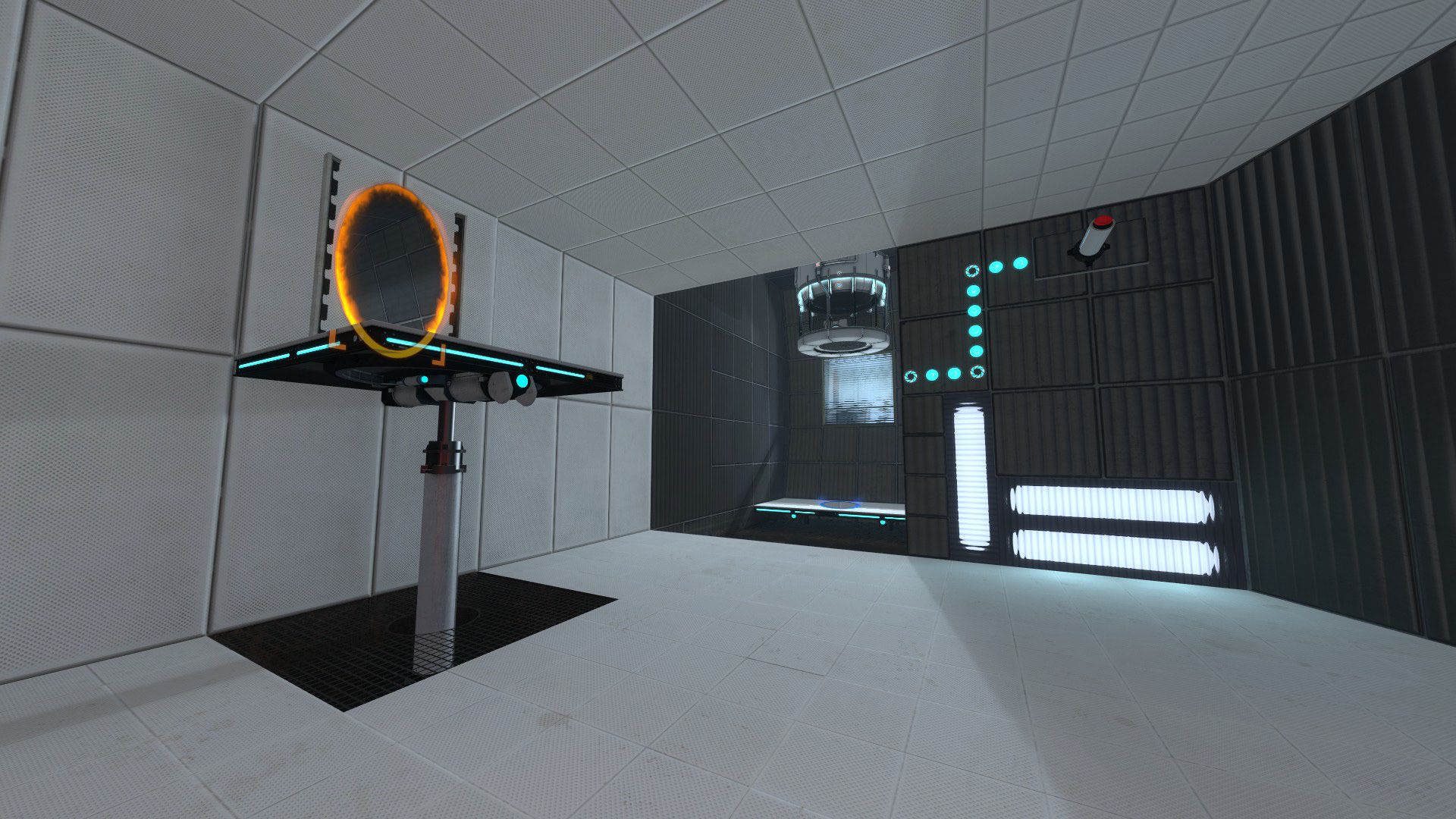
Firstly, the Test Chambers:
The Test Chambers are where GLaDOS wants the player to stay. They have clean lines, smooth concrete and minimal colour with a general flat lighting. These combined give the feeling of sterility.
Whether it is the soft snuggle of a knitted jumper or the skin-crawling feeling of polystyrene, materials can cause a range of emotions in the physical world, these emotions can also be transferred over into the virtual world. The issue here is that materiality and emotions are subjective and change from person to person. The cosy knitted jumper that I mentioned maybe pleasant to me but for some provoke memories of itchy and uncomfortably hot jumpers forced on during Christmas time. So when Portal 2 uses concrete some may see it as a cold, industrial material whereas some may see it as modern and stylish. What Portal 2 does to achieve the sterility of space is the way they use the material. There is liberal use of concrete and corrugated metal with highlights of electric blue - the only warm colours seen are the orange portals created by the player. This cold colour palette is used in hospitals and laboratories as it is considered to be clean and also in a more practical aspect red blood can be seen better on white, blue and green. The lighting in the Test Chambers are a cool-white fluorescent. This cool-white light is generally not used in bedrooms, lounges and restaurants as it is a stimulating light source. The 4000 kelvin colour temperature of cool-white lights means that there is a subtle blue hue to the light. Blue lights stimulate the brain and decrease the production of melatonin - the sleep hormone. Blue light is used to keep people awake and energised, perfect for puzzle testing in a prison/laboratory such as Aperture Laboratories.
Combine this antiseptic colour palette with the windowless spaces and piped-in lighting the Test Chambers become a thoroughly unappealing and depressing space. The lighting and materials so far have only given the player a sense of the hygienic and limiting space of the Test Chamber, however, combined with the palette of the Backend, the designers have created an entire new space within in the same facility.
The Test Chambers are where GLaDOS wants the player to stay. They have clean lines, smooth concrete and minimal colour with a general flat lighting. These combined give the feeling of sterility.
Whether it is the soft snuggle of a knitted jumper or the skin-crawling feeling of polystyrene, materials can cause a range of emotions in the physical world, these emotions can also be transferred over into the virtual world. The issue here is that materiality and emotions are subjective and change from person to person. The cosy knitted jumper that I mentioned maybe pleasant to me but for some provoke memories of itchy and uncomfortably hot jumpers forced on during Christmas time. So when Portal 2 uses concrete some may see it as a cold, industrial material whereas some may see it as modern and stylish. What Portal 2 does to achieve the sterility of space is the way they use the material. There is liberal use of concrete and corrugated metal with highlights of electric blue - the only warm colours seen are the orange portals created by the player. This cold colour palette is used in hospitals and laboratories as it is considered to be clean and also in a more practical aspect red blood can be seen better on white, blue and green. The lighting in the Test Chambers are a cool-white fluorescent. This cool-white light is generally not used in bedrooms, lounges and restaurants as it is a stimulating light source. The 4000 kelvin colour temperature of cool-white lights means that there is a subtle blue hue to the light. Blue lights stimulate the brain and decrease the production of melatonin - the sleep hormone. Blue light is used to keep people awake and energised, perfect for puzzle testing in a prison/laboratory such as Aperture Laboratories.
Combine this antiseptic colour palette with the windowless spaces and piped-in lighting the Test Chambers become a thoroughly unappealing and depressing space. The lighting and materials so far have only given the player a sense of the hygienic and limiting space of the Test Chamber, however, combined with the palette of the Backend, the designers have created an entire new space within in the same facility.

Now we move to the Backend:
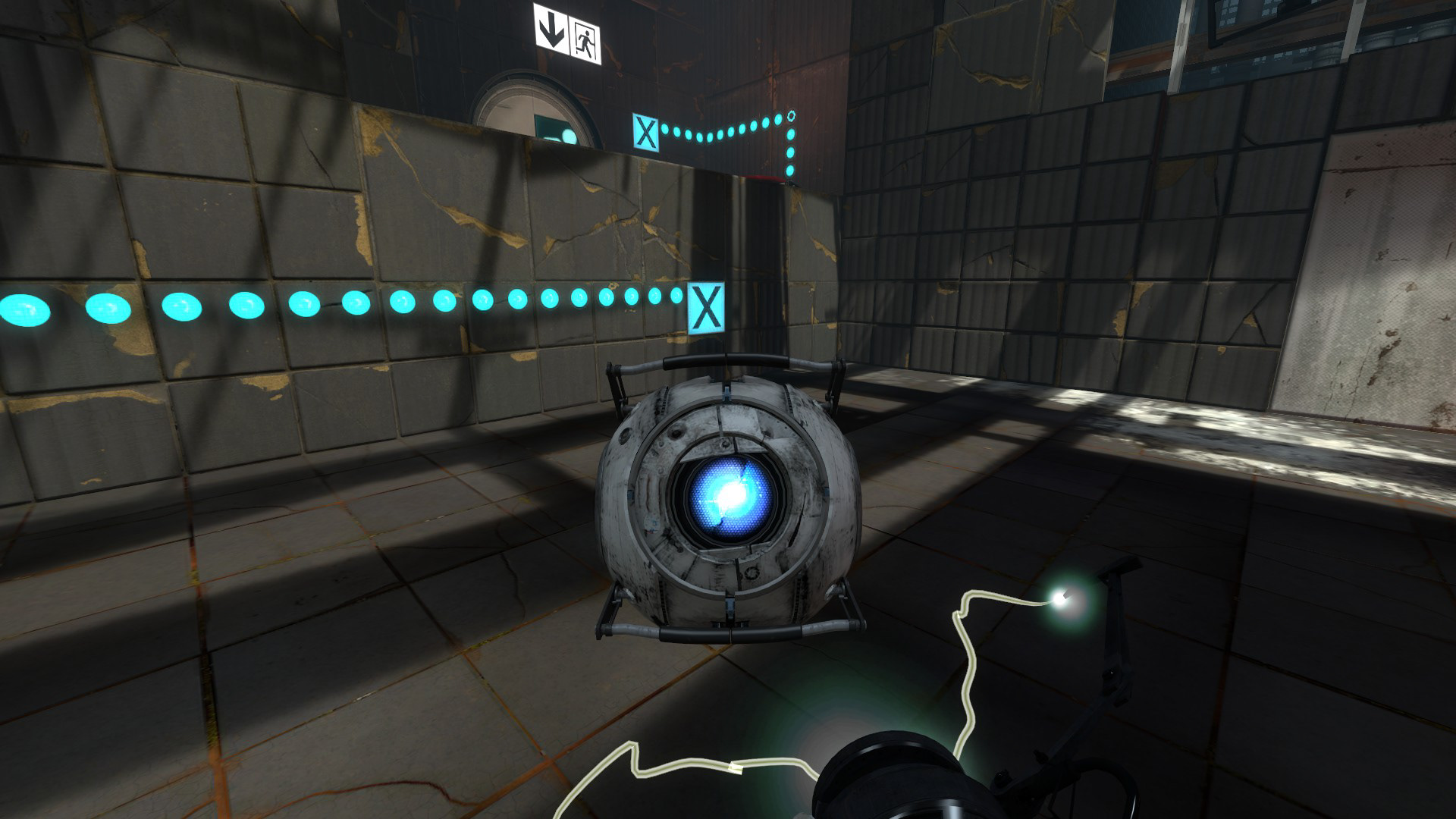
The Backend is the space outwith the Test Chambers but still inside Aperture Laboratories. Here there are old, disused offices and scrapped Test Chambers. The player has now entered the forbidden area where GLaDOS is no longer in control of the player must do.
We can see that the space is similar to the Test Chambers as we have the same concrete floors and walls with corrugated metal panelling and fluorescent bulbs. The difference is that these elements are dilapidated, rusting and aged.
This change in ambience not only aids the player in understanding that they are progressing in the game but it also give the player a better understanding of setting. The player is told that time has passed since the original Portal, however that is anywhere between 50 to 50,000 years. Here we now have visual confirmation. The building is falling to pieces and there is no sign of life anywhere. This change in aesthetic helps push the narrative farther but in the context of level design the materials and especially the lighting helps guide the player through the game.
The Backend is the space outwith the Test Chambers but still inside Aperture Laboratories. Here there are old, disused offices and scrapped Test Chambers. The player has now entered the forbidden area where GLaDOS is no longer in control of the player must do.
We can see that the space is similar to the Test Chambers as we have the same concrete floors and walls with corrugated metal panelling and fluorescent bulbs. The difference is that these elements are dilapidated, rusting and aged.
This change in ambience not only aids the player in understanding that they are progressing in the game but it also give the player a better understanding of setting. The player is told that time has passed since the original Portal, however that is anywhere between 50 to 50,000 years. Here we now have visual confirmation. The building is falling to pieces and there is no sign of life anywhere. This change in aesthetic helps push the narrative farther but in the context of level design the materials and especially the lighting helps guide the player through the game.

Gone are the clear instructions from GLaDOS and Wheatley and gone is the flat, sterile lighting. Now we have lights that maybe, possibly guide us? The lights do highlight important aspects of the level, however, they shouldn’t be relied upon to complete the level. The player can follow the lights to find areas of interest and importance but they still need to use their own intuition to complete the puzzles. The new lighting scheme can confuse and disorientate the player but this all adds to enjoyable challenge that is Portal 2. The materials can also help the player navigate through the levels. As previously mentioned the materials are now aged and worn but the change is colour palette is a positive one. The coolness is gone from the spaces and is replaced with a warmer yet outdated high-pressure sodium lamp, which creates a yellow glow in many of the spaces. This warm aesthetic indicates to the player that they are heading in the correct direction. This yellow colour palette is repeated throughout the following levels with the introduction of slippery, orange propulsion gel and as the player is getting closer to the outside world more and more natural light can be seen.
With an excellent use of colour theory and materiality the designers have successfully ensured that Portal 2 takes the player on an emotive journey. In a game that is tricky to navigate Portal 2 does everything it can to flatten the learning curve.
Navigation: Linear and Non-linear
As I said, Portal 2 is tricky to navigate. There is a constant sense that maybe you are not going in the correct direction and you should probably turn around and check out a different door but instead you persevere with your current path. This map that can be found in game clearly shows that the laboratory is a series of vertical structures beneath the surface. A clear example of linearity.

This sense of bewilderment is what helps Portal 2 - a linear game - feel non-linear. Non-linear games are those that can be explored such as open-world and RPGs, whereas with linear games there is a strict story and solution to each level. The way Portal 2 achieves this non-linear feel is by instead of having loading screens between all levels in the form of riding on the lifts, some levels are connected by a series of walkways and passages. The player can also explore different rooms and interact with different pick-ups that in the end have no real reason for existence other than expanding the game world.
One example is the “Secret Picture” Easter egg which once found on an old Aperture Laboratories computer reveals a companion cube on the moon. This is a nod to the original concept ending for the game.
This variety allows the player to feel like they have control over where they go and what they do once they are there.
This variety allows the player to feel like they have control over where they go and what they do once they are there.

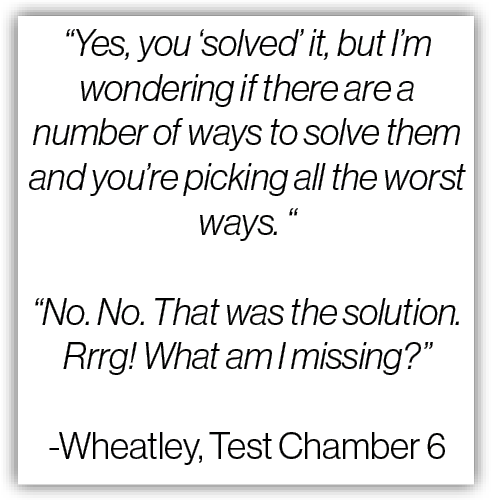
There is also no single pipeline that the player feels they must follow, no one corridor that they player returns to after each level. They are moving forward and upward and backward and downward navigating the series of interconnecting chambers, offices and warehouse. The designers have made these connecting corridors and rooms feel equally as important as each defined level. Problem solving and puzzling is still necessary even when the player is outside of a level. This gives the player a sense of choice and that maybe there is more than one option on how to complete the levels and the overall game. In the words of Wheatley, the player will inevitably solve the puzzles in the way they have been designed.
With this abundance of choice that has little to no consequence is what prompts the player to explore every avenue of the laboratory but another gameplay element that keeps the player engaged is the playable cutscenes.
The cutscenes still allow the player almost full autonomy over their avatar. Whilst dialogue is continuing whether from GLaDOS, Wheatley or the Fact Core the player can wander around. The player may not be able to shoot portals or interact with other objects they will be berated for not paying attention and chastised for leaving the area. This added dialogue and interactivity gives the player the sense of freedom during the game.
The cutscenes still allow the player almost full autonomy over their avatar. Whilst dialogue is continuing whether from GLaDOS, Wheatley or the Fact Core the player can wander around. The player may not be able to shoot portals or interact with other objects they will be berated for not paying attention and chastised for leaving the area. This added dialogue and interactivity gives the player the sense of freedom during the game.
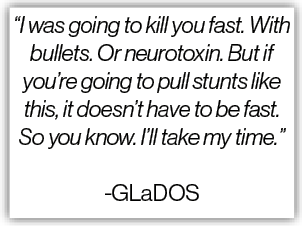
The game allows the player to feel in control of their own destiny whilst still maintaining a linear gameplay. The balance is achieved through dark humouress narrative, complex puzzle design, intriguing environments and the ability to combine all these features into a vivid game world which is confined to the four walls of Aperture Laboratories.
