Released: 2018
Producer: Rob Nelson
Lead Game Designer: Imran Sarwar
Producer: Rob Nelson
Lead Game Designer: Imran Sarwar
Red Dead Redemption 2 (RDR2) is the visually stunning prequel to 2010’s Red Dead Redemption. RDR2 follows the adventures and exploits of Arthur Morgan gun-slinger and member of the Van der Linde gang of the late 1800s. The Wild West has all but been tamed and the vast plains and dense forests of Northern America are shrinking leaving little room for outlaws, now the Van der Linde gang must adapt to the changing times.
Emoting: Environment Design
Aside from the complex characters, the nuanced plot and the brilliant animations what really draws me into this game is the longing I feel for a time and place long gone. A time and place that I was never a part of; The Olde West. The infinite skies stretching over the unbroken horizon to the prosperous unknown. So how does RDR2 create this heartache deep inside me? Through beautiful environment art and design.
I will begin with this one geological feature. Two tabletop mountains rise above a dried river bed, which is now used as a main road between the local towns.
In the early chapters of the game this site for me became a wayfinding point as I knew the safety of camp was just through the gully and on into the forest. This feeling of safety is generated by the fact that before now the surroundings are flat and open with very few trees and nowhere to hide. This lack of hiding becomes a problem as the nearby town becomes a hotbed of enemies and fleeing them becomes challenging when there is nothing to hide behind. So upon seeing the mountains rise out of the plains the player not only knows that they are close to camp but also this is a somewhere they can escape persecution. Riding up into the mountains forces the enemies to lose visual on the player and as such stops searching.
In the early chapters of the game this site for me became a wayfinding point as I knew the safety of camp was just through the gully and on into the forest. This feeling of safety is generated by the fact that before now the surroundings are flat and open with very few trees and nowhere to hide. This lack of hiding becomes a problem as the nearby town becomes a hotbed of enemies and fleeing them becomes challenging when there is nothing to hide behind. So upon seeing the mountains rise out of the plains the player not only knows that they are close to camp but also this is a somewhere they can escape persecution. Riding up into the mountains forces the enemies to lose visual on the player and as such stops searching.
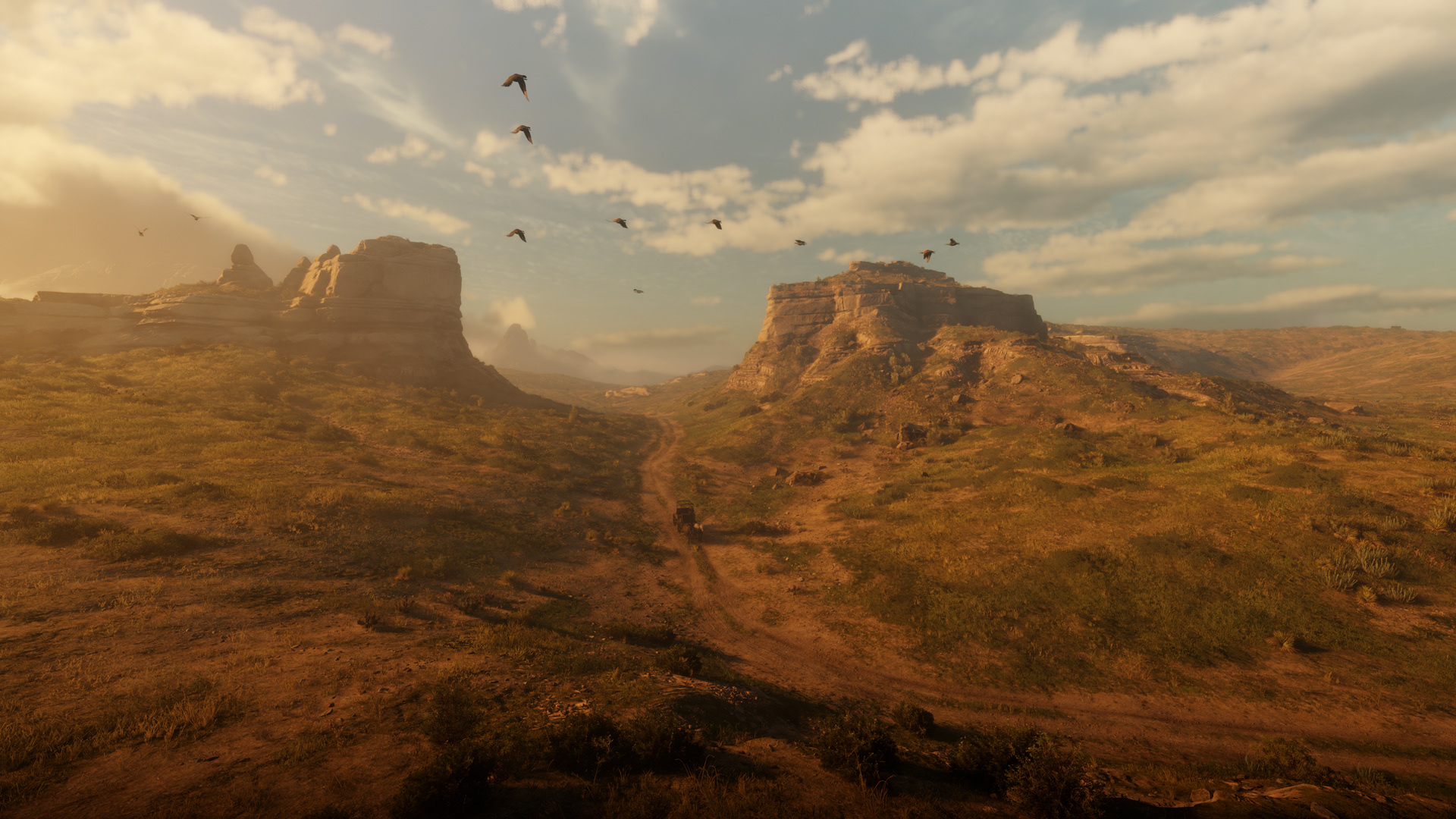
This is not to say that this area is always safe and lovely to see. As this is a funnel that forces the player to go through it, the designers have created random events to happen in the gully - namely bandits waiting to shoot and steal from you. (This is where I lost my first horse, RIP Eve). Adding these random events ensures that the game is lively and interesting, as nice as it would be to have a permanent home in RDR2 that just doesn’t happen. So through this simple addition of a natural bottleneck in the landscape the environment designers have given themselves a plethora of opportunities to keep the player engaged. As has been said these environments are vast and I mean sprawlingly huge! How do they pack so much vastness into a game? Is there a VAST button on a level designers keyboard? No. It is a simple architectural trick using juxtaposed environments called Expansion by Compression. This involves the user transitioning between a small space into a large space, and the contrast of the two side by side makes the big space seem very big. For example, walking through a tight corridor and exiting into a grand, airy atrium. The atrium will feel larger because the user had just had the walls next them being very close and then not. It’s like a taking a breath after holding it for a long time.
When used in videogames, this transition into a larger space is usually used to indicate when something is going to happen; this could be a boss battle, discovering a new location or simply moving between cutscene to gameplay. All of these are applicable to RDR2 - from moving between small saloon to open streets for a shoot-out or running through dense forest to reveal a magnificent vista of mountains and plains.
The sweeping landscapes of the Heartlands shrink down to the small communities of the local towns. Valentine is the player’s first encounter with one of these towns. Packed with the essentials Valentine is a busy community with many opportunities for debauchery and degeneracy.
When used in videogames, this transition into a larger space is usually used to indicate when something is going to happen; this could be a boss battle, discovering a new location or simply moving between cutscene to gameplay. All of these are applicable to RDR2 - from moving between small saloon to open streets for a shoot-out or running through dense forest to reveal a magnificent vista of mountains and plains.
The sweeping landscapes of the Heartlands shrink down to the small communities of the local towns. Valentine is the player’s first encounter with one of these towns. Packed with the essentials Valentine is a busy community with many opportunities for debauchery and degeneracy.

The protagonist Arthur longs for the west but throughout the game is traveling further and further away. He longs for the grand open spaces and free air but with each chapter the landscape because more congested with man-made structures imposing on the skyline. Valentine is the beginning of this. Even though it is set in the same lands of the tabletop mountains the placement of the structures obscure this. The mountains behind the town are blocked by the tall roofs of the saloons and shops and the blue skies are criss-crossed with telephone wires resembling the bars on a cage. These elements make the player feel enclosed and makes Valentine and other towns difficult to escape as there is no clear route out.

This feeling of being trapped is amplified when the game moves down south to the city of Saint Denis.
Saint Denis is city full of juxtaposition, from attending formal parties hosted by the mayor to trudging through monster infested swamps, all the while being surrounding by opulent playhouses and touring chimney stacks belching out smoke. The city could not be any farther from the comfort of the Heartlands.
Saint Denis is city full of juxtaposition, from attending formal parties hosted by the mayor to trudging through monster infested swamps, all the while being surrounding by opulent playhouses and touring chimney stacks belching out smoke. The city could not be any farther from the comfort of the Heartlands.
The architecture of the streets is typical of the time; neoclassic pillars, balconies with flower boxes, wood panelling and large sash windows. The way that the artists utilise this to their advantage is by repeating these features in all the streets and slightly tweaking them. This almost-repetition helps the player feel lost and longing for a Weenie to use a landmark.
This confusing, labyrinthine street contrasts heavily with the expansive plains, but even when the player leaves the hustle of Saint Denis they still aren’t in the beloved lands, instead they are cantering through sticky swamps where if they were to deviate from the roads the likelihood of treading on a snake or alligator is very high.
This progression of environments from sun-soaked prairie to small town, swamp to city reflects in the character development of Arthur as he becomes more and more disillusioned by the gang’s ongoings. The beautiful landscapes are far behind him much like the glory days of the Olde West and all that seems to be laid in front of him are the regimented streets of “civilised” society.
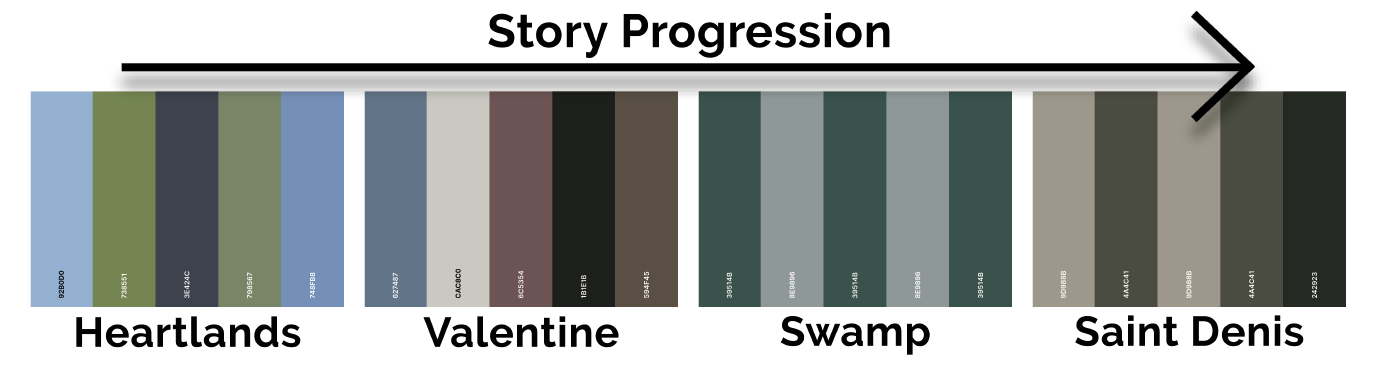
This sadness is evident in the colour scheme of the environments, beginning in the heartlands with big blue skies and green grass, moving into muddier browns of the well beaten roads of Valentine, into the dark greens of the swamps and then the greys of brick in Saint Denis. The loss of vibrancy is symbolic of Arthur’s development and mood.
The story’s progression carries on into Central America when everything changes again, however, for this analysis I am going to leave it here when Arthur leaves the States and this journey continues on.
This progression of environments from sun-soaked prairie to small town, swamp to city reflects in the character development of Arthur as he becomes more and more disillusioned by the gang’s ongoings. The beautiful landscapes are far behind him much like the glory days of the Olde West and all that seems to be laid in front of him are the regimented streets of “civilised” society.
This sadness is evident in the colour scheme of the environments, beginning in the heartlands with big blue skies and green grass, moving into muddier browns of the well beaten roads of Valentine, into the dark greens of the swamps and then the greys of brick in Saint Denis. The loss of vibrancy is symbolic of Arthur’s development and mood.
The story’s progression carries on into Central America when everything changes again, however, for this analysis I am going to leave it here when Arthur leaves the States and this journey continues on.
The environments of RDR2 is one of the biggest draws for me as a level designer as it demonstrates how much the emotions of a level can be altered by adding in simple aesthetic details. Through the gradual change of scenery the designers have made it possible for a player to long for a bygone era and home they never knew.
Emoting: Environmental Foreshadowing
As a gun-slinging, horse-riding, shoot-out action-adventure game the necessity for foreshadowing is essential. The player cannot simply ride around and be expected to be ready for a fight around every corner, this is were level design and asset placement becomes useful.
Back to the city of Saint Denis for this bit of analysis. The Van der Linde gang have just hijacked a street-car after a robbery, the street-car is careering along heading toward an inevitable crash and derailing. Below is that moment that the street-car jumps the tracks and crashes.
The street-car has crashed into a horse-drawn cart with hay-bales piled into the back, shown on the far right of the image. The debris is thrown over the road and the street-car comes to a halt.
Back to the city of Saint Denis for this bit of analysis. The Van der Linde gang have just hijacked a street-car after a robbery, the street-car is careering along heading toward an inevitable crash and derailing. Below is that moment that the street-car jumps the tracks and crashes.
The street-car has crashed into a horse-drawn cart with hay-bales piled into the back, shown on the far right of the image. The debris is thrown over the road and the street-car comes to a halt.

Not only does this added shrapnel make for a more visually engaging scene, it also sets the player up for what is to come - a shoot-out.
With the Van der Linde gang lying in tumult, noises of a gathering police force can be heard from outside. The player gets to their feet and stumbles their way out of the street-car onto this scene:
With the Van der Linde gang lying in tumult, noises of a gathering police force can be heard from outside. The player gets to their feet and stumbles their way out of the street-car onto this scene:
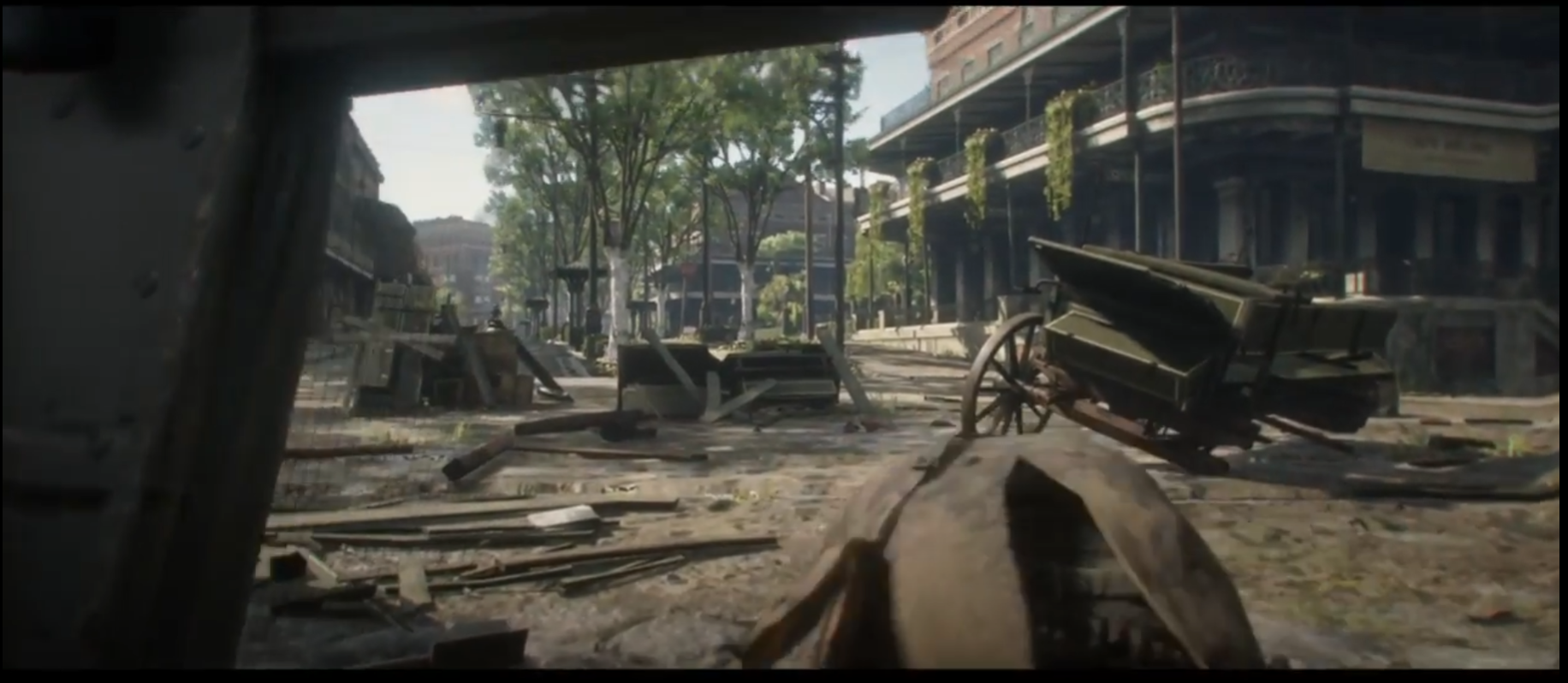

We can see here the cart that was just destroyed by the street-car and various other assets strewn about. With the placement of each asset the player can interpret that a shoot-out is about to commence as the assets are organised in such a way that they can be used for cover from an onslaught of gunfire but are staggered in such a way that they can progress up the street. This is also a good example of Expansion by Compression. The player crawls out of the small space of the up-turned street-car out onto the broadest street of Saint Denis. The exitway of the streetcar frames the street in such a way to allow the player to be able to see the cart and other debris lying over the street. The player is also given enough time to identify the location of the police officers and select appropriate cover.
This expansive space combined with the asset placement lets the player know that there is going to be a change of pace in the game and the player had been alert to this prior to the crash. The player is now prepared for a shoot-out thanks to the level design.
This type of foreshadowing is used throughout the game and the player slowly learns to intuit the signals that action will be happening in this space, from boulders placed next to an abandoned building to doors hanging off of their hinges.
This expansive space combined with the asset placement lets the player know that there is going to be a change of pace in the game and the player had been alert to this prior to the crash. The player is now prepared for a shoot-out thanks to the level design.
This type of foreshadowing is used throughout the game and the player slowly learns to intuit the signals that action will be happening in this space, from boulders placed next to an abandoned building to doors hanging off of their hinges.
However, in keeping with being an intriguing and engaging game this isn’t always the case. Many environments have this type of asset placement but no action. RDR2 is set during a time of national upheaval and civil war so having these assets (such as old gravestones and disused battlements) placed in such a way that suggests a gun-fight is about to happen helps develop the game world instead. This red-herring keeps the player engaged as they traverse the landscape and every once in a while an emery may appear in one of these locations through the random events.